In any hotel, labour is the single largest operating expense, typically accounting for over 40% of revenue with housekeeping teams often the largest single department within that1. Many operators assume that housekeeping costs are a given with the focus on headcount: how many housekeepers are on shift, how many rooms need turning? But that’s only part of the picture. The more important question is how much of your team's time is actually being used productively, and how much is being swallowed up into processes that are slower, harder, and more physically demanding than they need to be.
The answer, for most hospitality operations, is that a significant amount of time is being lost. Not dramatically. Not in ways that are easy to spot on a report. But consistently, across every shift, in ways that add up to a real and recoverable cost.
The costs that hurt most in housekeeping are rarely the ones on any single budget line. They show up in other ways.
A mopping system that requires constant refilling adds minutes to every room. A waste run that requires four trips across multiple floors when one would do burns through shift time that could go elsewhere. Equipment that is awkward, unstable, or physically demanding leaves staff fatigued by mid-shift, slowing the pace of every clean that follows. And when physical strain becomes a daily reality, people leave. Recruiting and training a replacement costs time and money that most operators have not budgeted for.
None of these feel like big problems individually. Together, they represent a significant and largely invisible drain on your operation.
The clearest evidence for how much time better equipment can recover comes from a time and motion study carried out with a leading UK care organisation, comparing their existing setup with an upgraded collection of cleaning and waste movement tools. Although the context is care rather than hospitality, both experience the same operational pressures and are therefore directly comparable, and the findings are worth taking seriously.
Like hotels, large care sites operate across multiple floors with rooms that need cleaning quickly, consistently, and to a high standard. Like hotel housekeeping teams, care cleaning staff handle repetitive physical tasks across long shifts, manage waste movement across large footprints, and work under constant time pressure.
The results of the study were significant. By upgrading cleaning equipment and waste movement tools, the organisation achieved:
A 33% reduction in weekly room cleaning time
A 21% reduction in daily room cleaning time
Waste movement time cut from 30 minutes to just 5 minutes
Four waste trips reduced to one
Projected productivity savings of £11,235 per site annually (based on repurposing resource elsewhere due to more efficient waste movement. Projection based on six cleaners per site earning national living wage).2
These are not marginal gains. They are the kind of numbers that change what a housekeeping team can realistically achieve in a shift and what it costs to run one.
The study identified several specific points where poor equipment was creating unnecessary friction. The problems? Mopping systems that were fragile and complex to refill. Mop pads that wore out quickly and lost floor contact after washing. High-level dusters with thin, unstable poles that were slow and difficult to use. Waste movement that required repeated trips because equipment lacked the capacity to consolidate runs.
The answer? The introduction of simple improvements to cleaning equipment and processes.
Quicker cleaning
The HYGEN™ PULSE™ Microfibre Mop Kit removes the need for repeated bucket refills entirely, with an onboard solution reservoir that lets staff control fluid release on demand. Floor cleaning becomes faster and requires less physical effort, with fewer interruptions and less strain across a shift.
The HYGEN™ Quick-Connect Flexi Wand reaches high and awkward areas without stretching or climbing, making high-level cleaning safer and quicker.
Better waste workflows
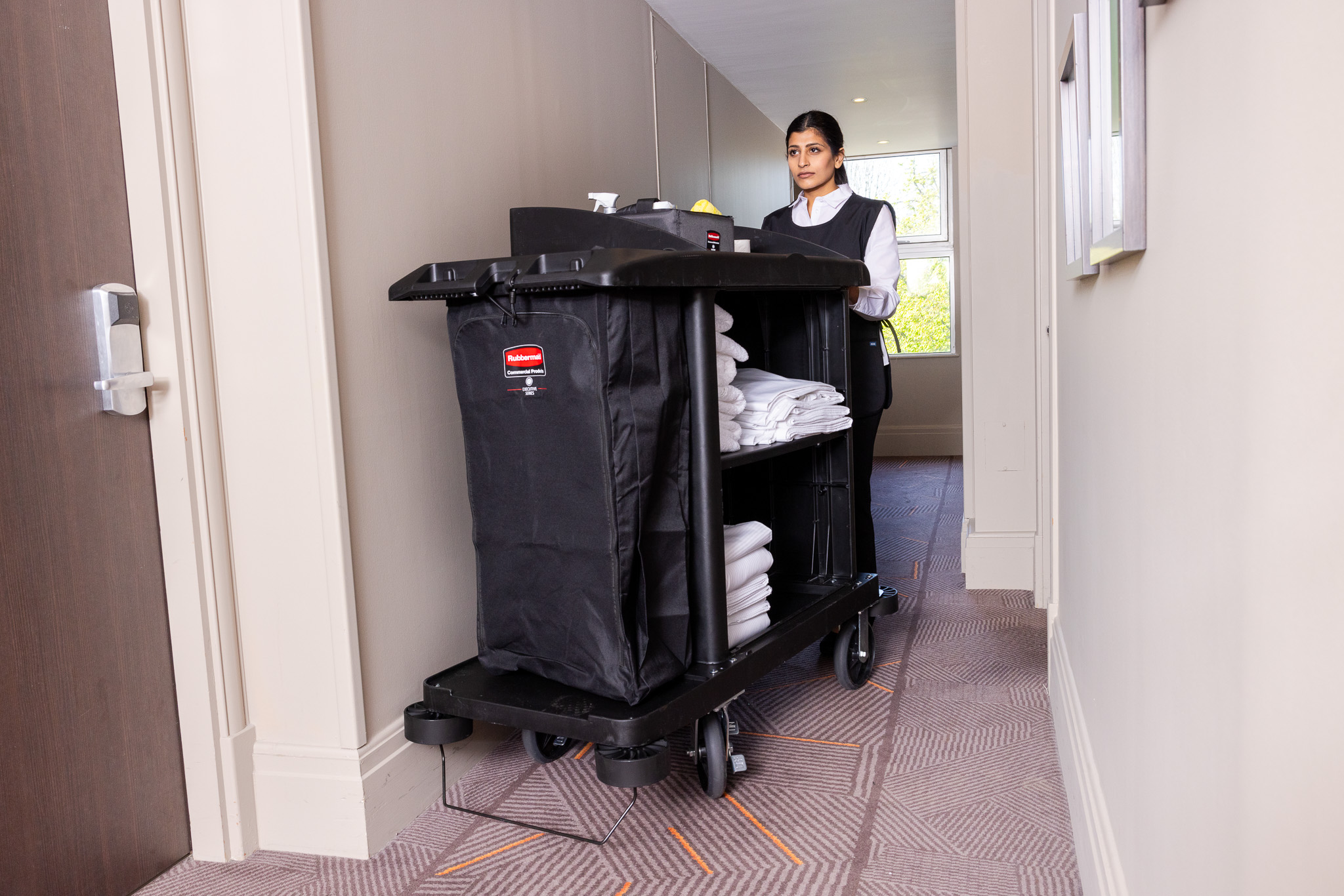
For waste and linen movement, the Collapsible X-Cart consolidates what previously required multiple trips into a single run. Lightweight, manoeuvrable, and high-capacity, it removes one of the most time-consuming elements of a housekeeping shift. For room turns and deep cleans, the Full-Size Housekeeping Cart carries everything needed in one journey, quiet enough not to disturb guests and durable enough to handle the demands of daily use.
There is a second cost that sits behind all of this, and it is one that hospitality operators know well. With hotel workers having a 40% higher injury rate than all service sector workers – and housekeepers coming off worst – it's easy to see why housekeeping suffers from high staff turnover rates3. Looking after the wellbeing, both physical and mental, of your staff mean you’re less likely to cough up for costly recruitment and training.
Providing better tools that reduce physical load is both the right thing to provide for the people doing this work, and a straightforward commercial argument for investing in equipment that lasts and performs.
If you have never done a structured review of how long your housekeeping processes actually take, the starting point is simpler than it sounds. Time a room turn from start to finish. Count how many trips your waste movement requires. Watch where your team stops, waits, refills, or struggles - and ask whether that friction is necessary. For most operations, the answer is no. And the time and cost that removing it recovers is more significant than most operators expect.
Indeed Flex UK: labour costs in hotels typically reach just over 40% of revenue. https://indeedflex.co.uk/blog/for-employers/how-to-reduce-labour-costs-for-your-hospitality-business/
Rubbermaid Commercial Products (2024). Counting the Hidden Cost of Care Home Cleaning: Practical Steps to Improve Productivity and Control Costs
LightSpeed Stage of the Global Hospitality Industry 2022
Share on Social Media