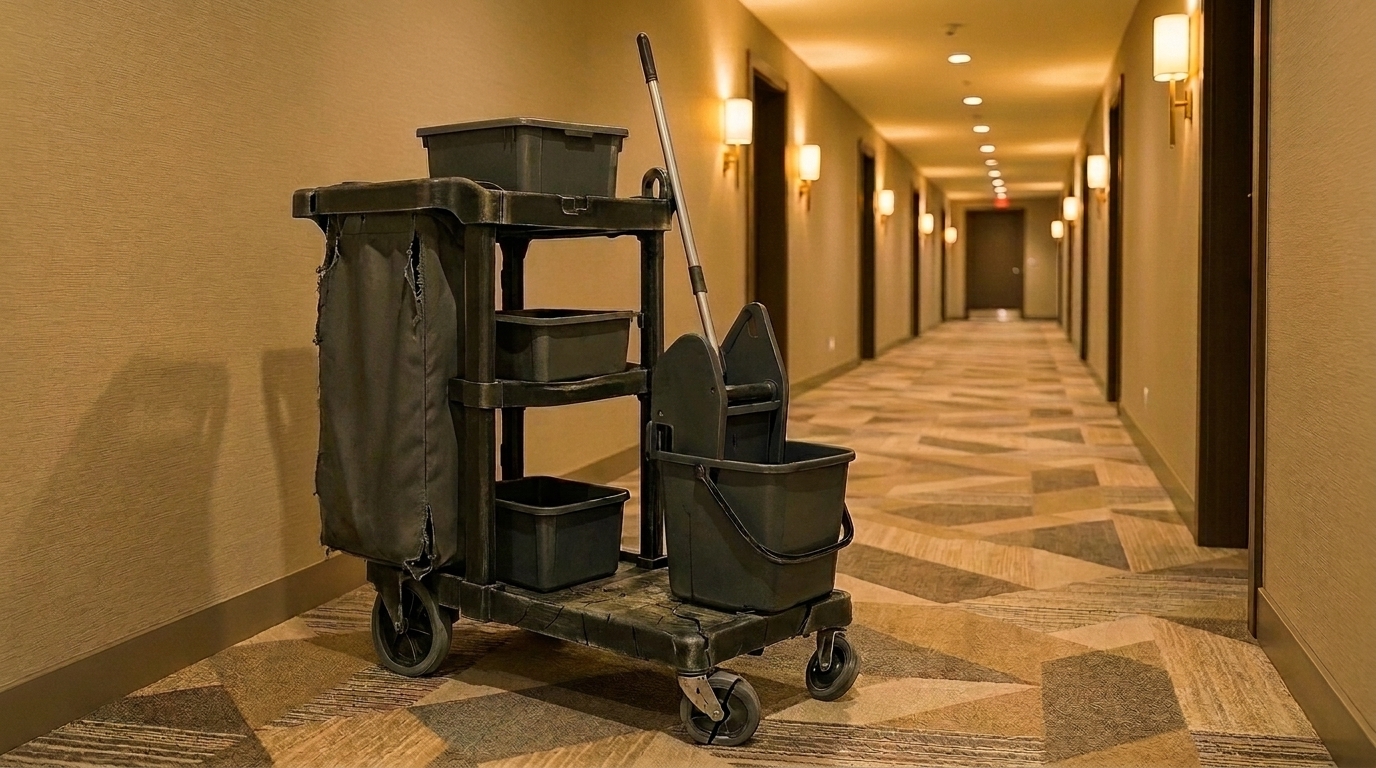
When a housekeeping trolley breaks down mid-shift or a platform truck gives out while taking a delivery to your kitchens, most operations managers focus on one number: the replacement cost. But that single replacement unit cost on a procurement request is rarely the full picture. The real cost of equipment failure is easy to underestimate because it sits across multiple budget lines, impacts different areas of your operation, and is almost never totalled in one place.
In this blog you can see how equipment failure can cause knock-on costs throughout your venue, and learn how to build a framework that takes the full cost into account.
One failure, multiple costs
When an operational or equipment failure occurs, getting the costs all in one place can be tricky because of all the moving parts in your venue. Here’s what you should be taking into account when assessing the benefits of investment in more durable equipment:
1. Room turnaround and productivity loss
When a housekeeping trolley or linen cart fails, for example, the team member relying on it cannot work at full capacity. During peak turnover - late morning checkout through to early afternoon check-in - that disruption could create a backlog that takes several hours to clear. Rooms that miss the turnaround window affect guest experience, front desk scheduling, and potentially the ability to sell the room into an arriving guest's slot. In a fully booked property, the knock-on could be felt across the entire floor.
2. Maintenance, repair, and the replacement cycle
Before a failed unit gets replaced, there is an assessment process: can it be repaired? Who handles disposal? Each step has a time cost and, often, a direct spend attached. If equipment is failing and being replaced regularly, the procurement administration overhead - raising orders, managing delivery, training staff - adds up further.
3. Risk of injury
Between a piece of equipment failing and a replacement arriving, your team may attempt to manage loads using inadequate alternatives or manually carry items that should go on a utility trolley. Not only is there the obvious wellbeing concern, the costs of an injury from moving loads incorrectly - such as sick pay and staff replacement - add another line to the total impact of equipment failure. Something that definitely wasn’t in the budget when you were looking at the cost of a housekeeping cart.
Building a framework for your own hotel
There is no single formula for calculating the cost of a cart, truck or trolley failure. But looking at the different areas impacted by that failure can help you track down the total costs. Before your next procurement decision, run through these against your own operation:
What is the cost of a delayed room turnaround, especially during peak period?
What does maintenance, repair, and disposal cost per unit per year?
What is the total cost of your current replacement cycle, including procurement time?
If a team member was injured using inadequate equipment and needed time off, what would that cost your operation?
When you look at the cost of these categories together, you start to see the real-world worth of choosing durable, long-lasting equipment over ones that are cheaper up front.
Choose equipment built to last in busy venues
At RCP, we take pride in manufacturing equipment that holds up in busy venues, and when teams choose our products they feel the true value. Of UK respondents who have purchased RCP between in the 12 months up to September 2025, 94% rated it as "worth it”, and shoppers who are considering RCP , select ‘tough’ and ‘reliable’ as words to describe our products.*
Our material handling and cleaning mobility ranges are designed for the reality of a busy hotel shift. They’re built with high-performance materials and made to move ergonomically, whether you’re doing cleaning rounds with a housekeeping cart, moving heavy linen in an X-cart, or transporting waste in a tilt truck.
Our BRUTE® material handling products, including utility trolleys, each carry a warranty of up to 10 years, and our housekeeping carts and Rubbermaid platform trucks have a warranty of up to three years. We also understand that durability can’t come at the expense of manoeuvrability, which is why we ensure our material handling and cleaning mobility products are also ergonomic. Our housekeeping carts, for example, include 360° casters and a handle design that supports a comfortable, even grip.
To discuss how our durable material handling and cleaning mobility solutions could support your facility, contact our expert team.
*"Worth it" combines respondents rating RCP as 'Somewhat Worth It' or 'Very Worth It' on a 10-point scale. Based on a sample of 212 respondents. Newell Brands Brand Health Tracking Study, UK Jan San Masterbrand, October 2024 to September 2025, conducted by Langston on behalf of Newell Brands.
Based on brand association data from Newell Brands Brand Health Tracking Study, UK Jan San Masterbrand, H2 2025, conducted by Langston on behalf of Newell Brands, among UK brand considerers (respondents who indicated they would consider purchasing from RCP). 'Tough/Resilient' and 'Reliable' are pre-defined attributes from a prompted list presented to respondents.
Share on Social Media