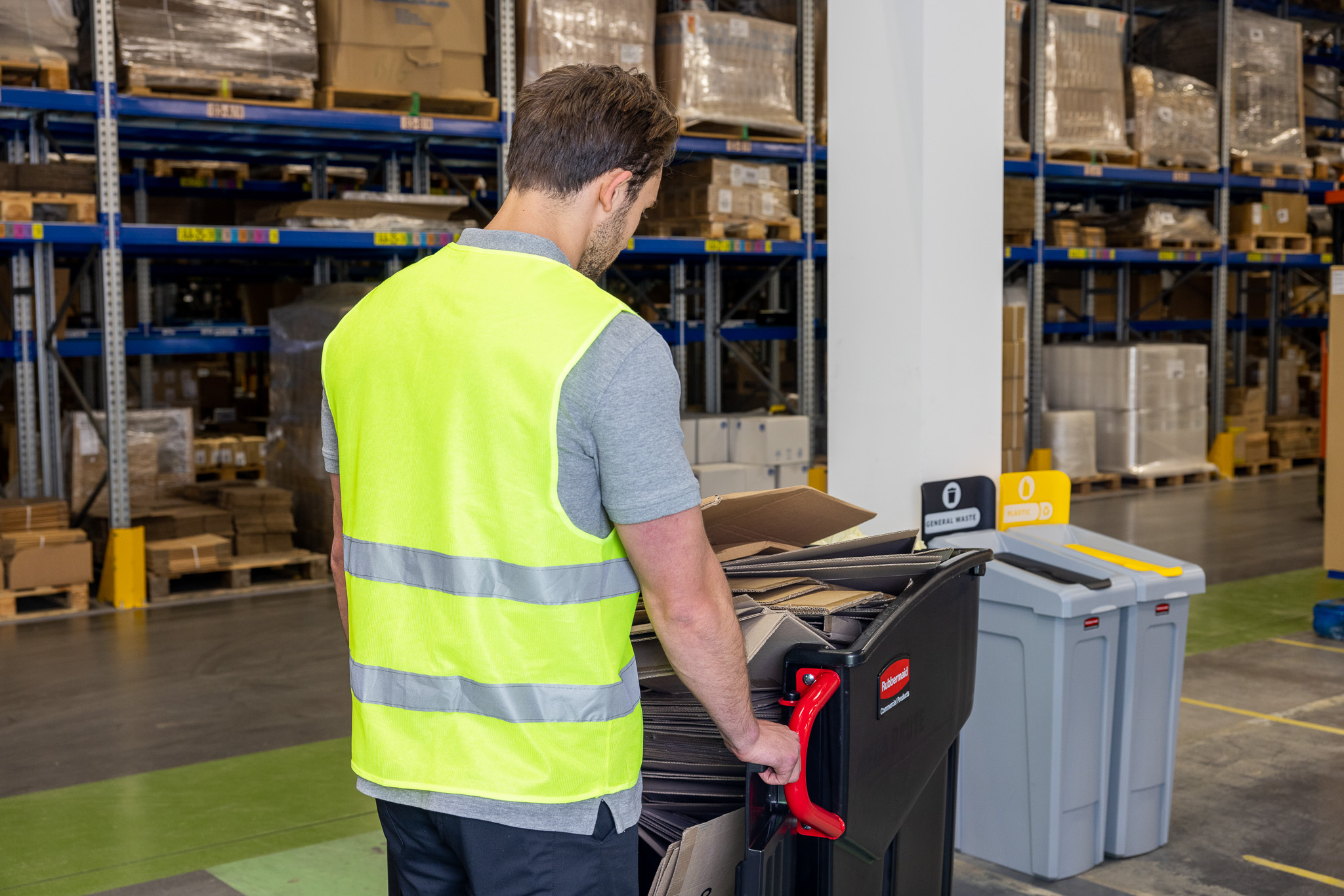
Recycling has long been treated as something the facilities team sorts out. Bins go here, a policy goes on the noticeboard there, and operations gets on with the actual job.
But the introduction of Simpler Recycling legislation has changed what businesses are legally required to do with their waste. And with Digital Waste Tracking becoming mandatory from October 2026, the consequences of getting it wrong are about to become a lot more visible - and a lot more costly.
For operations managers, this is not an abstract compliance issue. It is an operational one. Poor waste infrastructure creates safety hazards, slows throughput, and generates penalties that hit the P&L. This is a practical brief for ops managers who need to understand what has changed, what it means for their sites, and what getting it right actually looks like.
What Simpler Recycling actually means for warehousing and logistics
Simpler Recycling standardises the waste streams that all businesses must separate at source. From March 2025, businesses in England with ten or more employees are required to segregate dry recyclables (glass, metal, plastic, paper and card), food waste, and residual waste for separate collection. Businesses with fewer than ten employees will be included from March 2027.
For warehousing and logistics sites, this is not a marginal change. Your facility likely generates substantial volumes of cardboard and packaging waste, plastics from wrapping and consumables, and food waste from canteen and break room areas. That waste is generated across the operation - at loading bays, packing stations, and across the warehouse floor.
The assumption that this sits entirely with facilities is no longer workable. When waste is generated at that scale, across multiple points on a site, what happens at the point of generation is an operational responsibility. Poorly positioned, under-specified, or failing infrastructure does not just create a compliance gap. It creates a workflow problem.
The operational cost of getting it wrong
This is where it gets concrete for ops teams. Infrastructure that cannot handle the volume and pace of an active warehouse creates bottlenecks. Workers make extra trips to centralised waste points, or they take shortcuts - dumping mixed waste into the nearest bin to keep pace with throughput targets. Both outcomes cost you. The first adds non-productive movement to every shift. The second generates contamination that results in rejected loads and penalty charges from your waste contractor.
Then there is the safety risk. Bins that are not built for industrial environments crack under forklift or pallet jack impact. Cracked bins create sharp fragments. Sharp fragments are a FOD hazard. That is not a facilities issue - it is a shutdown risk.
Poor seals on food waste containers create hygiene failures fast, particularly in warmer months. A pest control incident does not just cost money to fix. It can result in your waste contractor refusing collection, leaving you with a mounting problem on site and an unplanned operational disruption.
None of this shows up as a compliance failure in the traditional sense. It shows up as downtime, lost picks, contamination penalties, and maintenance hours that could have been avoided.
Why Digital Waste Tracking raises the stakes
Digital Waste Tracking becomes mandatory in October 2026. From that point, waste movement from site will be logged, tracked, and reportable in an online portal. Every load that leaves your site will form part of a documented chain.
Contaminated loads and poor segregation will not simply result in a rejected collection - they will leave a record. What was previously an invisible operational nuisance becomes a documented failure with an auditable trail attached.
For ops managers already responsible for supplier performance data, audit documentation, and site risk management, this is a familiar problem in unfamiliar territory. The quality of on-site segregation will directly affect what gets reported downstream - and potentially how your waste contractor assesses your site going forward.
The time to fix the infrastructure is before that system goes live, not after the first flagged load.
What getting it right looks like in practice
Compliance is not achieved through policy alone, and neither is operational performance. Both depend on having the right infrastructure in the right places, so that correct segregation happens consistently - without relying on repeated retraining or goodwill during a busy shift.
On a warehousing or logistics site, that means clearly separated, high-capacity waste streams positioned where waste is actually generated: loading bays, packing areas, and canteen spaces. It means infrastructure that handles operational volume without creating a bottleneck or a manual handling risk. And it means point-of-use positioning that reduces the distance workers need to travel - because every unnecessary trip to a centralised waste station is time not spent on productive work.
For high-volume, high-demand environments, our BRUTE® containers, dollies, and material handling trucks are built to take the punishment of an active warehouse floor without slowing operations down, and with a 10-year warranty to back it up.
Where space is tighter - at packing stations, in corridors, or along production lines - the Slim Jim® range provides a compact, clearly labelled solution that fits within standard aisle and floor markings without compromising stream separation. And for communal or canteen areas where multiple waste streams need to be captured in one place, Configure™ offers a flexible, high-capacity solution that makes correct segregation straightforward for the people using it.
Durable, well-positioned infrastructure reduces the operational risk at the source. That is where the problem starts, and that is where it needs to be solved.
The clock is running
Ops managers are already responsible for site safety, throughput efficiency, and risk management. Waste infrastructure is now part of that picture - and the October 2026 Digital Waste Tracking deadline means the window to get ahead of it is closing.
The cost of doing nothing is not zero. It is downtime, contamination penalties, safety incidents, and a compliance record that is increasingly difficult to dispute.
Review your current setup now - not after the first rejected load.
Explore how our range supports compliant, high-performing waste segregation across your site: get in touch with the team.
Share on Social Media