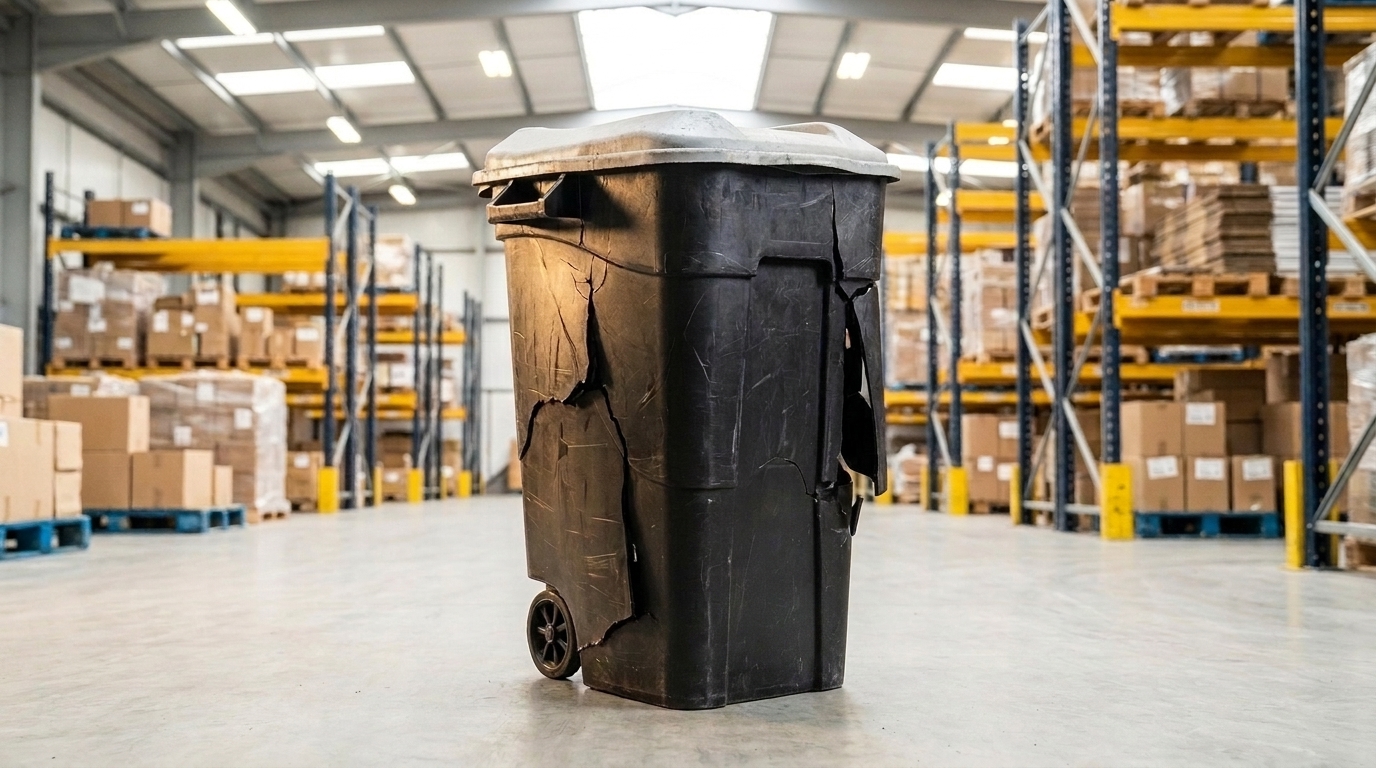
Picture the scene: it’s a busy morning during peak season. A cracked bin in the goods-in area has split off a shard of plastic onto the conveyor. Nobody noticed it go. The fragment travels through the system, ends up in an outbound shipment, and is found by the client.
That is not a maintenance issue. That is a Foreign Object Debris incident. And depending on your sector and your client contracts, it could mean a shutdown, a formal notification, and a conversation about whether your facility meets the standards required to keep the contract.
The bin was under-specified for the environment it was working in. And the cost of replacing it upfront would have been a fraction of what the incident is now going to cost.
FOD: the risk hiding in plain sight
Foreign Object Debris is an ever-present operational risk in warehousing and logistics - one that rarely arrives from outside the facility. The risk is present in any high-throughput warehouse or distribution centre where waste infrastructure is operating under sustained physical stress.
Cracked bins near conveyor belts, goods-in zones, and outbound despatch areas are a practical source of that risk. Plastic fragments from failing containers could contaminate packaged goods, create slip or trip hazards on the warehouse floor, or introduce debris into machinery.
The problem is that waste bins tend to be treated as background infrastructure. They get specified once, replaced reactively when they visibly fail, and rarely feature in risk assessments until something goes wrong. By that point, the conversation has moved from maintenance to incident management.
The true cost of under-specified equipment becomes visible only after something has gone wrong. Buying to the lowest available price is a rational short-term decision, but it is a more difficult position to defend once a FOD incident has occurred and the full cost - operational, contractual, reputational - is on the table.
Who is accountable when it goes wrong?
Health and safety managers and operations managers in warehousing environments carry accountability for the safety of their sites. That accountability does not stop at the machinery or the PPE policy. It extends to every piece of equipment on the floor - including the bins.
When a FOD incident occurs, the question asked in the investigation isn’t "why did the bin crack?" It's "why was a bin in that condition in active use on the floor?" The answers that follow - it was due for replacement, it was the wrong specification for the environment, it was bought to a price rather than a standard - are the answers that land with the person who signed off the procurement, or the person responsible for site safety.
Framing waste infrastructure as a cost line rather than a safety input is where that exposure begins. Under-specified bins are not primarily a budget problem. They are a safety risk that operations and health and safety managers are already accountable for - whether or not the procurement decision was theirs to make.
Why the risk is higher right now
Two factors make this worth addressing now rather than at the next procurement review.
Seasonal and temporary workers.
Peak periods bring additional headcount, and that shift in workforce composition can create a gap in operational awareness that is easy to underestimate. If a bin in the loading bay has a small crack developing at the top, that’s the kind of thing long-term staff might have picked up on, but may be missed by someone new.
Temporary workers may also be less likely to flag equipment issues, whether that’s because they are unsure of the correct process, or just don’t want to slow things down during peak period.
Heat and material brittleness.
Lower-quality plastic bins can become more brittle under sustained heat - in loading bays, in areas with direct sun exposure, or in facilities with limited climate control during summer months. A container that passed a visual inspection in February may behave differently in July under the same physical loads.
A framework for assessing your bin specification
Before the next procurement cycle, it is worth running your current bin specification against the environment it is actually working in:
Are your bins rated for the physical loads they are taking, and can they handle other risks like impacts from forklifts?
Are they maintaining structural integrity in all temperatures of the areas they’re placed in?
Are they being inspected regularly, and is there a clear process for taking a cracked or damaged bin out of service before it becomes a source of fragments?
Do you know the total cost of your current replacement cycle, including the cost of emergency replacements when a bin fails mid-shift?
If any of those questions raise concerns about the equipment in your warehouse or the processes you have in place, it may be time to invest in higher quality equipment and build a plan with other managers.
Choose products that can handle every shift
At RCP we take pride in designing bins that can actually handle heavy work, day in day out. And when we talked to UK respondents who have purchased RCP between in the 12 months up to September 2025, 94% rated it as "worth it”. Even the shoppers who haven’t bought from us yet, but are considering RCP select ‘tough’ and ‘reliable’ as words to describe our products.*
Because we know that when the work cannot stop, neither can the products supporting it.
In a warehouse or distribution centre where bins take knocks from trolleys and forklifts, durability is key. Our BRUTE® containers are built from resin designed to flex on impact and return to shape rather than crack or deform under sustained load.
They’re also backed by a 10-year warranty, which you can take into consideration for the total cost of ownership and set against a cheaper alternative that may need replacing several times in the same period.
It’s a level of toughness you can take beyond your bins, too. The BRUTE® material handling range of trucks and trolleys is also built to withstand busy industrial environments, while carrying loads up to 952kg.
Where space is tighter - think goods-in areas, outbound shipment zones, or spots alongside conveyor belts - the Slim Jim® Recycling Stations and Slim Jim® Vented bins are designed to fit into narrow footprints without compromising on capacity or airflow. Built for the same demanding environments, they give operations the flexibility to place waste and recycling infrastructure exactly where it's needed.
For operations where waste infrastructure sits near conveyor belts, goods-in areas, or outbound shipment zones, the specification decision is not just a procurement question. It is a safety one.
*"Worth it" combines respondents rating RCP as 'Somewhat Worth It' or 'Very Worth It' on a 10-point scale. Based on a sample of 212 respondents. Newell Brands Brand Health Tracking Study, UK Jan San Masterbrand, October 2024 to September 2025, conducted by Langston on behalf of Newell Brands.
Based on brand association data from Newell Brands Brand Health Tracking Study, UK Jan San Masterbrand, H2 2025, conducted by Langston on behalf of Newell Brands, among UK brand considerers (respondents who indicated they would consider purchasing from RCP). 'Tough/Resilient' and 'Reliable' are pre-defined attributes from a prompted list presented to respondents.
Share on Social Media