Every summer, hospitality operations shift into survival mode. The focus is on getting through service, keeping covers turning, and managing the team through some of the busiest weeks of the year. But this time is also an opportunity to learn so you can make the next peak more manageable.
The pressure, the pace, and the weight of a sustained busy period will expose every gap in your back-of-house setup - waste infrastructure, cleaning equipment, and efficiency of how your team moves through a shift. Treated as signals rather than inconveniences, identifying these gaps gives you a clear picture of what to fix before Christmas arrives and the stakes are high once again.
Here’s where to look, and what to ask.
Waste handling: when volume exposes the gaps
The signs are familiar by now. Bins that overfill before they’re collected. Bags that split under the weight of a busy service. Waste points that turn into bottlenecks during peak hours, pulling staff away from where they need to be.
None of these are simply peak season problems. They are signs that your waste infrastructure is not matched to the volume your operation actually generates.
The questions worth asking
A waste walk is one of the simplest ways to spot where your setup is working against you. As you move through your space, note down what's actually happening against each of these:
Are waste collection points where your team needs them, or are people carrying loads further than they should?
Is bin capacity keeping up with output, or are containers being overfilled as a workaround?
Is the manual handling of heavy or overfull containers creating a safety risk for your team?
Are the right bin types in the right areas - or is one solution being asked to do too many jobs?
Honest answers to these questions will tell you more than any product spec sheet. Use our Waste Walk Guide to structure your review and record what you find - it's designed to help you map the gaps before you make any decisions.
Once you have a clearer picture of what each area actually needs, the Product Selector Tool can help you find the right bins for each space.
Cleaning equipment: performance under pressure
During peak times, the gap between equipment that’s inadequate and equipment that’s right for the job becomes impossible to ignore. Cleaning cycles that run long, tools that slow the team down, or kit that breaks under the pressure of table turnover are all telling you something.
The question most operations avoid is an honest one: has the cleaning equipment ever actually been reviewed for the environment it’s working in, or has it just been inherited and left in place?
If staff are working around limitations - taking longer than the schedule allows, making do with tools that aren’t the right fit for the surface or the pace - those workarounds are costing you time and affecting hygiene output. Summer peak makes those workarounds visible because there’s no slack in the system to absorb them.
Two products are worth looking at if floor and surface cleaning is where you're losing time. The HYGEN™ Pulse™ has an on-board 0.6L fluid reservoir that allows staff to clean up to 80m² of floor space without stopping to refill, with a trigger handle that dispenses cleaning solution on demand. The patented zig-zag scrubbing strips on the mop pad handle dried-on stains without requiring extra passes, and the high-absorbency head reduces water usage by up to 90% compared with a traditional string mop. Built to last and backed by a 3-year warranty, it's the kind of investment that pays for itself over time.
For surface cleaning, the HYGEN™ r-40 Recycled Microfibre Cloths are built to withstand up to 200 commercial launderings, with colour-coded options that make it straightforward to designate cloths by area or task and reduce the risk of cross-contamination. They remove 99.9% of tested fungi and bacteria using plain water, which means less reliance on chemical cleaning products during a period when speed and simplicity matter most.
Mobility and ergonomics: the hidden drain on people and productivity
This is the pressure point that gets the least attention, and often does the most damage across a sustained peak period.
Equipment that's awkward to manoeuvre, solutions that require more physical effort than they should, layouts that force unnecessary movement - individually, these friction points are manageable. Compounded across a 10-hour shift during a busy summer weekend, they create fatigue, slow turnaround times, and in the worst cases, injury risk.
The questions to ask: Are staff covering more ground than necessary because equipment isn't positioned to reduce movement? Is the physical demand of the kit creating fatigue that compounds over consecutive busy days? Are there improvements that would make a measurable difference to both speed and safety?
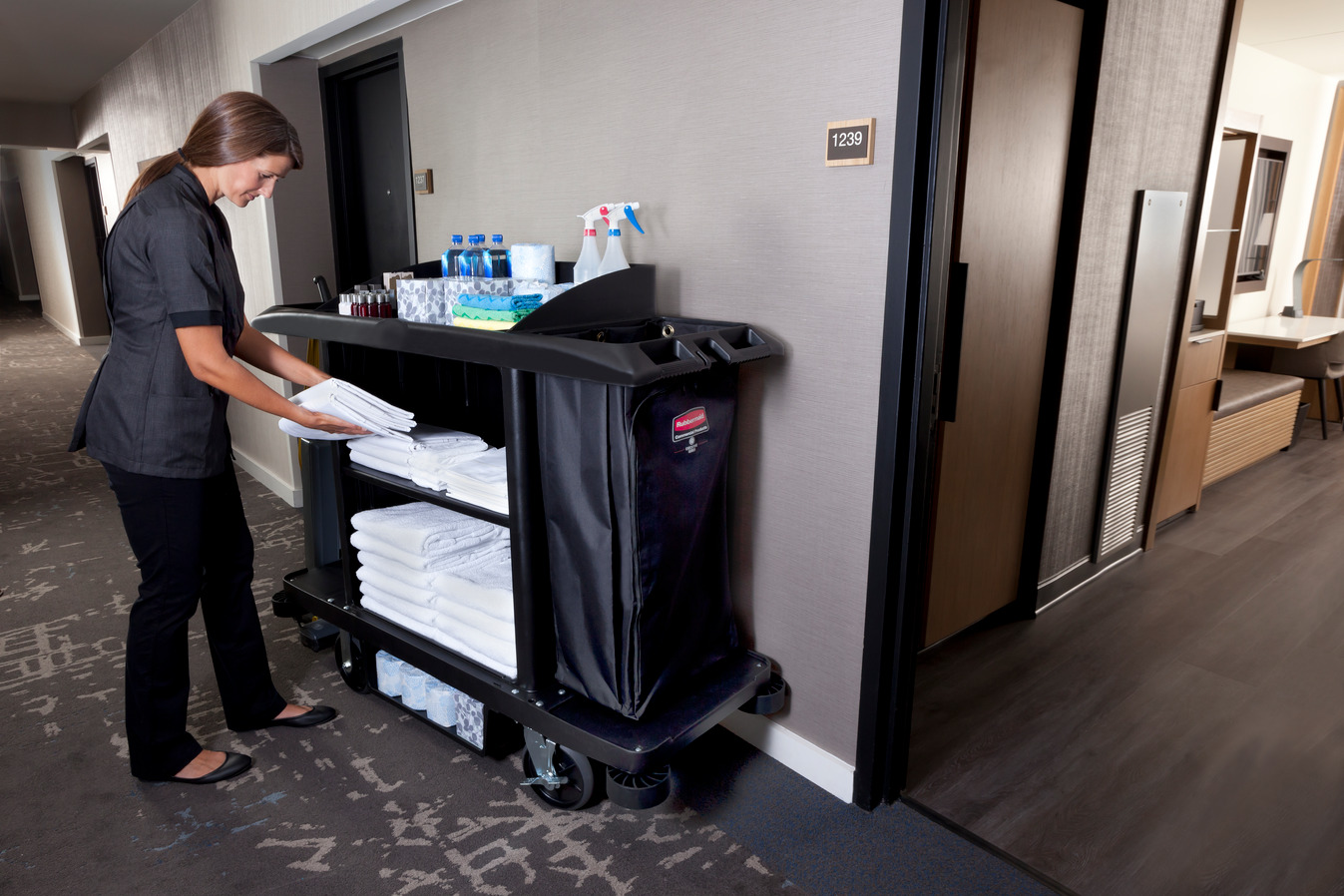
For housekeeping teams in particular, the answer often comes down to what they're moving around the building and how. The Executive Series™ Housekeeping Cart is designed as a complete system solution for exactly this environment - offering 360° manoeuvrability and customisable organisation with two adjustable shelves, so everything a team member needs for a full round of rooms or service areas is in one place. That reduction in back-and-forth trips is not a minor convenience during peak - it is time recovered across every shift. The Compact Housekeeping Cart offers the same manoeuvrability in a smaller footprint, useful where corridor width or storage space is limited. For areas where supplies need to stay out of sight, the Full Size Housekeeping Cart with Hood and Doors keeps everything contained and presentable in guest-facing spaces.
The principle across all three is the same: fewer trips, less unnecessary movement, and a team that arrives at the end of a peak shift having spent their energy on the work that matters rather than on covering ground they shouldn't need to cover.
For linen and waste collection, the X-Cart Trolley is worth considering alongside your housekeeping setup. Available in 150L and 300L capacities, it's collapsible for easy storage when not in use - a practical advantage in facilities where space is at a premium. Whether it's used for dirty linen on a room turnaround or waste collection between shifts, it keeps bulk loads moving efficiently without adding unnecessary strain on staff.
Don’t just get through it - learn from it
Waste handling, cleaning performance, and equipment ergonomics are not three separate problems. They are connected drains on the same operation. A team spending extra time managing overfull bins, working around inadequate cleaning tools, and covering unnecessary ground is a team that cannot work at its best - and that cost compounds during every peak period.
The businesses that come out of summer stronger are the ones that treat it as a learning opportunity rather than something to recover from. Take note of where the friction is. Ask the hard questions now. Use what you learn to go into Christmas better equipped.
To review your current setup and speak with a member of the RCP team, get in touch here.
Share on Social Media