If you work in warehousing and logistics, you’ll know that time is everything. Fulfilment targets, pick rates, throughput - every minute of every shift is accounted for.
In a sector where marginal gains can add up to make a big difference, optimisation is relentlessly pursued in an effort to remove the kind of unnecessary wastage that eats away at productivity.
But you might have been overlooking a consistent source of wasted time - not broken machinery, mispicks or staffing gaps, it’s your recycling system.
Recycling is more important than ever
Since the implementation of the Government’s Simpler Recycling legislation in March 2025, the waste management landscape for warehouse and logistics businesses has experienced a year of seismic change.
The latest example of an ongoing shift towards sustainability and responsible waste management, Simpler Recycling is just a small part of a raft of legislative changes that will put sustainability at the heart of operations.
Yet, while warehouse and logistics operations have been quick to implement changes to comply with new regulations, many haven’t stopped to consider the impact that the way these have been implemented could be having an impact on people’s productivity.
Waste in the LEAN sense of the word
You’ve no doubt heard of the term LEAN. Originally developed in the Japanese automotive industry, it’s a methodology that aims to boost efficiency by streamlining operations and reducing waste.
It’s a lens through which just about every aspect of your operations will have been viewed at some point. So why not use it for your recycling systems?
Take the idea of unnecessary motion, for example. Imagine your worker has to walk an extra 10 metres outside of their usual workflow in order to deposit cardboard in the appropriate bin. That might seem like a small inconvenience, but it’s a journey that happens dozens, if not hundreds of times a day. Multiply that across a team, in a huge facility, over multiple shifts and suddenly it adds up to a significant amount of time that contributes nothing to throughput.
Then there’s waiting. What happens if the recycling point the worker has travelled to fills up faster than it’s emptied? Or it’s too small for the volume of waste it has to handle? Suddenly, your people have to stop to pile waste nearby or deal with the issue themselves - an interruption that stops the flow of work dead in its tracks.
Finally, we should consider overprocessing. If your bins aren't clearly labelled or waste streams aren’t logically organised, your staff are forced to spend time decoding what goes where. These are decisions they shouldn’t need to make, creating the kind of pauses and low-level friction that LEAN works so hard to eliminate in other areas of your operation.
How to stop your system from stealing picks
Now that we understand the scale of the problem that inefficient recycling systems can cause, what can warehouse and logistics operators do to fix it? Fortunately, there are a few key changes that you can make that will have an immediate impact and help to claw back some of those lost picks.
Location, location, location - In a well-run warehouse the same thought is given to waste management locations as it is to pick paths. Put simply, getting the right bins in the right places is the single biggest thing that you can do to improve your system. It’s a high-impact improvement that you can repeatedly refine to make things as efficient as possible.
Labelling matters - Labelling is just as important as your hardware, so give it the attention it deserves. Consistent colour-coding throughout your facility and clear labels with recognisable iconography help make recycling easy for your users. Our label customisation tool lets you create clear, colour-coded signage tailored to your specific waste streams, reducing the decision-making burden on staff and cutting contamination at source.
Equipment that can keep up the pace - Once you get placement right, you should turn your attention to the equipment that forms the backbone of your recycling system. Look for bins with long warranties for durability you can trust.
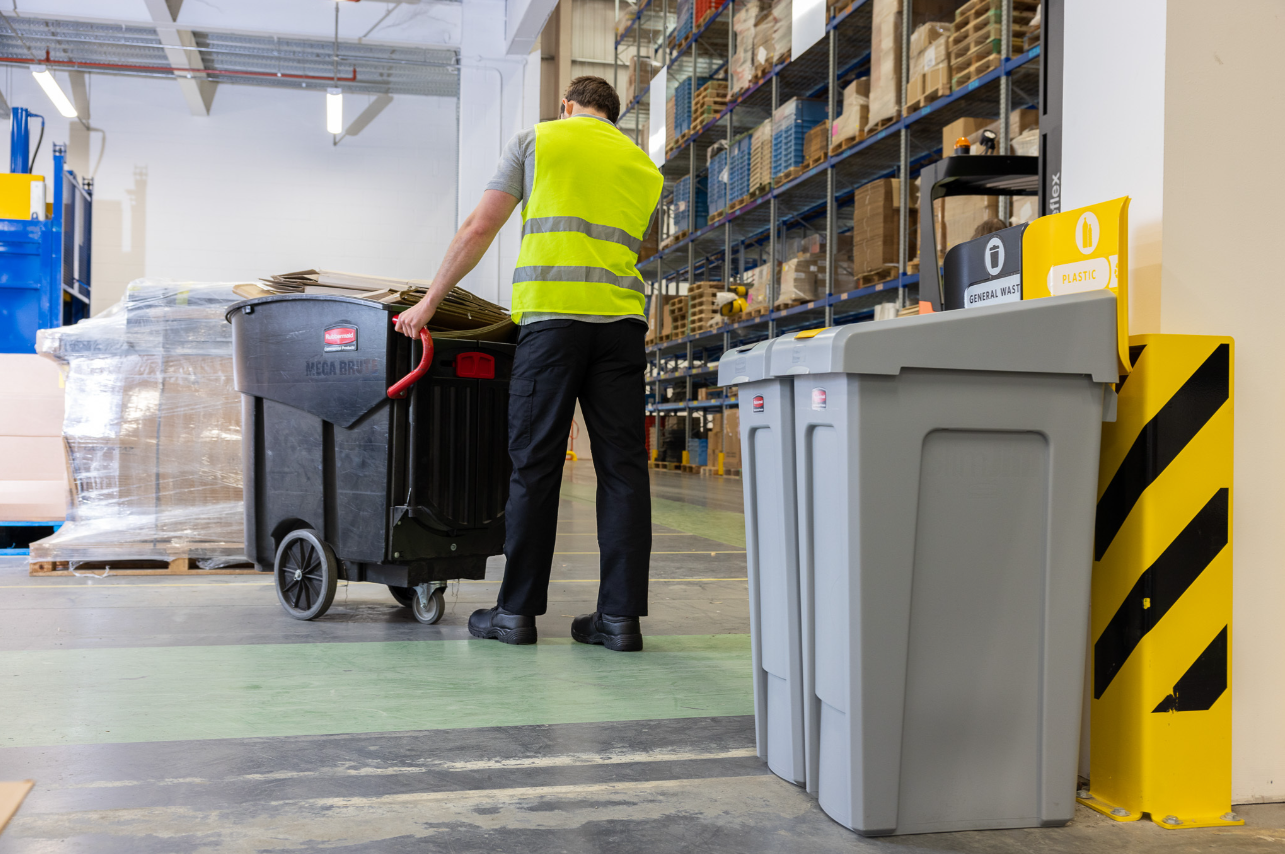
Our BRUTE® containers (10-year warranty) are a familiar sight in warehouses and logistics operations for good reason, as their large volume, exceptional durability, and easy movement make them ideal for even the busiest environments.
Where floor space is tighter and multi-stream separation is the priority, our Slim Jim® Recycling Stations (10-year warranty) offer a compact, clearly organised solution that makes getting it right as easy as possible for staff working at pace.
Get started with a ‘waste walk’
Walk your facility, taking a systematic approach to assess where your recycling set-up is working and where it may be falling short. What waste are you generating in each area and how much? Do you have the right recycling bins in place? Are you seeing cross-contamination of waste? These are the kind of questions you should ask yourself as you move around, helping you to make informed decisions that will improve your systems.
If you’re looking for help to get started, we’ve put together a checklist to help you to understand what to look out for.
Small changes, significant returns
No single recycling station is going to make or break a warehouse operation. But the cumulative effect of poorly designed waste infrastructure adds up to more than most operations realise.
The good news is that fixing these issues isn't going to cost you huge amounts of time or money. Often, it's about placement, capacity and clarity. Get those three things right and your system stops being a drain on productivity and starts doing exactly what it should - quietly and effectively delivering on your recycling objectives without stealing picks from your people.
Looking to unlock efficiencies at your facility? Our newly launched Recyclopedia can help. Filled with information, advice and best practice it’s got everything you need to transform your waste management system from a drain to a gain.
Share on Social Media